Reflections on Adam Holý and the Print Photograph

Just Me and Renata
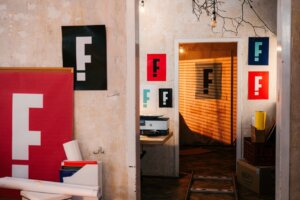
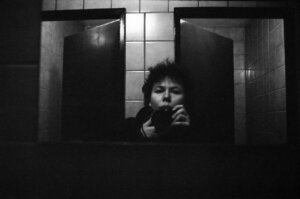
A few days ago, I visited Fotograf Contemporary Gallery to see their latest exhibition of David Holý’s photographs. I opened the door and stepped into an expansive, empty space, interrupted only by a massive print of the artist’s title portrait: Renata. I was the only person in the gallery until a bell triggered by the door alerted someone of my arrival. Across the gallery, an attendant greeted me from a door I hadn’t noticed. She informed me about the appropriate order in which to view the photographs and that the exhibition continued downstairs, then returned back to her elusive location in the back.
I’ve been to many art galleries, but I can never say I’ve been to one completely alone. It was pleasant to be able to take my time with Holý’s work uninhibited by the concern for my surroundings – like the anxiety of blocking others’ views or the feeling of a security guards’ stare. It was one of the few times in my life where I felt completely present without distraction. I felt I was experiencing the photographs rather than just looking at them.

Print and Permanence
This feeling revived my appreciation for the photographic print. Do you know how many photographs are taken on a phone every day? Meta estimates it’s about 4.7 billion. “That’s a lot of swiping, scrolling, and sharing,” they wrote. As photography became less of a technical skill (requiring knowledge about the technicalities of a camera or the developing process) and more of an expendable resource, our relationship to it changed drastically.
Photographs consumed digitally are as easily erasable as they are manufacturable, meaning as soon as we’ve had enough of looking at something or are unsatisfied with what we have taken, we have infinite chances to start over or try again. A physical, photographic print however, experienced in its intended setting, commands your attention. You can’t discard it so easily because it possesses physicality and permanence. As the sole viewer of Holý’s work at the time, I was directly confronted with the nudity, the blank stares, and the intimate vulnerability of his subjects. I was immediately greeted by his portrait of Renata, which I neglected to mention not only dangled from the ceiling, but was upside down and diagonal. My point is, when media of any kind exists tangibly, it is both limited and supplemented by its physicality. A person viewing a digital rendition of Renata would have a completely different experience than my own.
Holý’s photographs celebrate some of the best things about photography as a medium. They are spontaneous, imperfectly (yet masterfully) composed, and depict moments that are fleeting. As curator David Korecký wrote for the exhibition, “…he always chose images that provoke or unsettle through their rawness while simultaneously soothing the viewer with an intimately pleasant sense of déjà vu…” Unlike painting or drawing, photography has the advantage of immediate presence within a certain time and space. Like déjà vu, they remind you of your presence somewhere else.

Digital and Dissociation
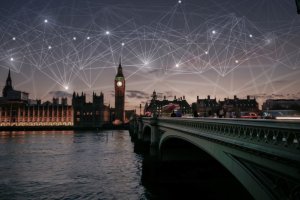
The exhibition had a second part – downstairs in the basement of the building. As I descended downward, I entered a dark room with a projection of photographs so unlike the ones I had just seen I questioned if they were Holý’s. They were disjointed, vignetted landscape images interrupted by gaping holes and warped shapes. And like many contemporary art installations you’ll encounter, uncanny music filled the room as it played. It was clear that there was some juxtaposition here. Korecký described it beautifully:
“The panoramic landscapes…represent a shift in Adam’s practice. It’s as if he had run out of the studio, dressing rooms, and catwalks full of masks and sets, only to assemble a broken world outside…no, no, it’s different: the world itself holds together, but our perception, interpretation, and framing of it are fragmented, pixelated, and partly obscured by the fragments of the devices we have enlisted in our service to bring the world closer and simplify it.” He likens the vignette to viewing the landscape from a bunker, writing that it serves as “…a symbol of refuge from our own fear, not a formal game, but an extremely refined psychosocial reflection on life in contemporary society.”
I could not have described my sentiments towards the technology I have not known a world without better myself. Not only consuming photographs, but consuming anything, by digital means comes with a compromise: we become engrossed in fragmented, hypersimplified versions of a reality catered specifically for us – our own personal Truman Shows. The photographs commonly circulating digital spaces are the same. They often lack context, authorship, and a deeper meaning beyond their aesthetic worth. Like the democratization of information that the digital age brought, the widespread accessibility to photography seemed like another step towards progress. We have more means to consume and create than any other time in history, so why do we feel like we view life from a bunker?
These are questions that countless media theorists have wrestled with. This exhibition does not attempt to answer such questions, but rather identify the sentiment many of us share. It synthesizes the physical with presence and the digital with absence.

Proč Míň?
I risk sounding like an analog purist when I pin digital photographs against printed ones – shaking my fist in the air and bewailing that “Photography used to be better before phones ruined it!” However, this is not my point – neither is it a true statement. The symptoms of printed photography’s death were present far before the release of the iPhone. It was in 1972 that Life magazine, America’s megaphone for photojournalism, announced it was releasing its last weekly issue. Why? Because the advertisers the publication relied on saw more opportunity in television. Without them, the magazine could not provide the grants which allowed photographers to produce long-form work, and the magazine shrunk until it went out of print in 2007.
Life magazine is just one example of how the arts suffer when the people they rely on no longer believe in their merit. The same thing which happened to Life is happening to organizations which support artists, journalists, and photographers. Just a few days ago, Fotograf Zone, the publication which owns the gallery I visited, announced it could no longer support the print issues of its magazine. “…the current model of Fotograf Zone is no longer financially or humanly sustainable,” the announcement read. “This is not the result of a single unsuccessful grant decision, nor of any one event in recent months. It is the result of changes and pressures that have been accumulating over many years.”
The survival of independent, print media is imperative for many reasons. It allows its receptors to have a different relationship with the information they are receiving unhindered by the limitations of digital platforms. It gives artists a place to express themselves unfiltered. I’m not saying you have to completely cut the cord to support artists, but as the recent campaign which overtook Prague, PROČ MÍŇ, suggests, why less? What is the benefit of not just less media but less kinds of media?
Luckily, Prague never lacks opportunities to support artists. Prague Art Week is about to wrap up, and after it, the DesignBlok festival will begin. I encourage you to not just read about these festivals or view pictures of them online, but to visit them in person. Fantastic and innovative work is being made every day, and there’s nothing like seeing it (in person!) to restore your faith in humanity.
PS: Polansky Gallery has a plan to publish a book on Adam Holý in the near future.
Comments